What Designers Built for Banking in Three Hours
The Brief
Retail banking is one of the most used services in everyday life. It touches everyone. And yet, ask most people how they feel about their bank’s digital experience and the answer lands somewhere between “fine” and “deeply frustrating.”
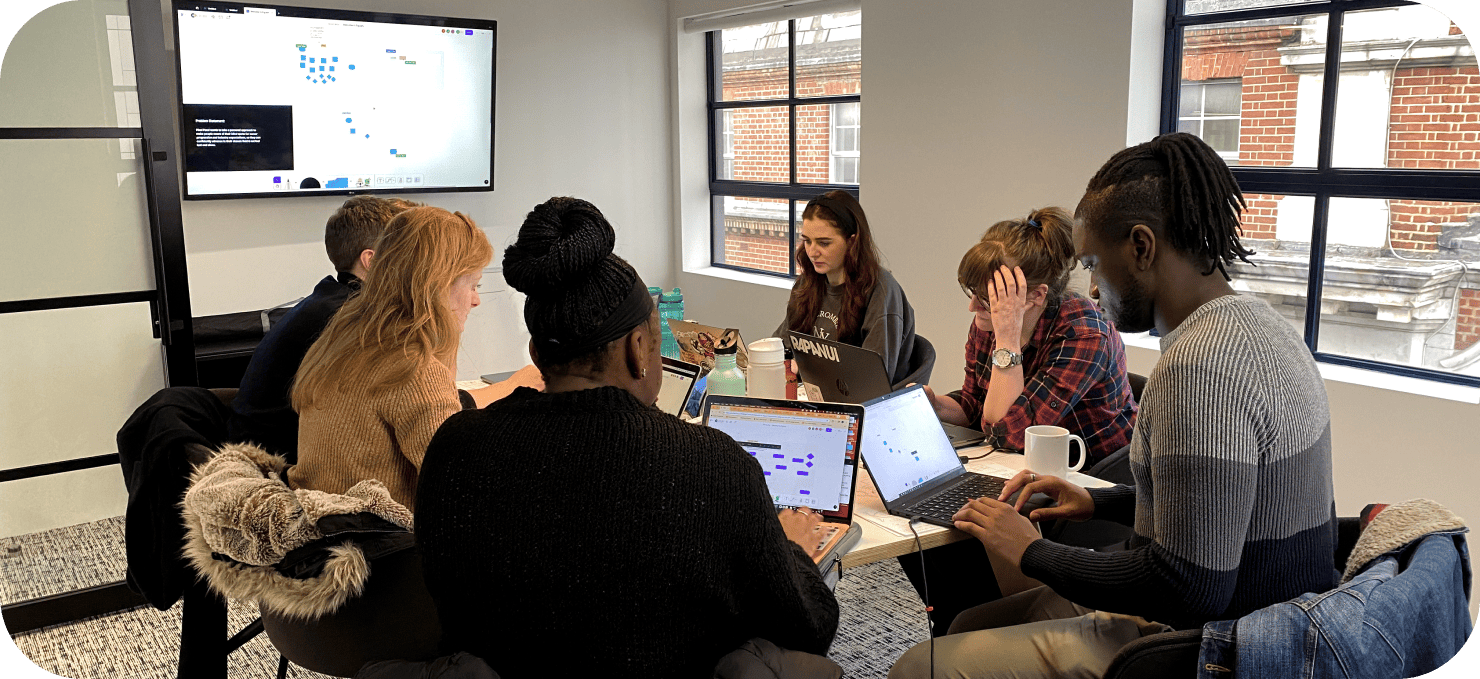
That gap was the starting point for our latest Curiosity Session. We brought together a group of students and instructors for an evening hackathon. The format was simple: three hours, pairs only, one tool (Figma Make), one brief. Design a retail banking experience, or feature, that is more human, more considered, or more empowering than what exists today. Prototype it. Pitch it.
A briefing pack went out 48 hours in advance. We wanted people to arrive having already sat with the problem. To have looked at the friction points, understood the opportunity spaces, and come in with a perspective. The data in that pack told its own story. 47% of customers abandon digital account opening before they finish. 76% would switch banks for a better digital experience. 39% name poor digital support as their primary source of frustration.
The opportunity is obvious. The question was whether a room full of designers, given real constraint and real freedom, could see things that banks have so far missed.
The Design Lenses
We gave participants four lenses to design through. Not a prescription, but a provocation.
- Customer experience. Banking is an emotional event, not just a functional one. Moments of clarity and confidence matter as much as speed. Design for the feeling, not just the flow.
- Service design. Most banking frustrations happen at the seams, between channels, between teams, between digital and human. The journey matters more than any single screen.
- Designing for intelligence. Interfaces that anticipate, learn, and respond to a customer’s real needs rather than just reacting to them.
- Human in the loop. Knowing when to step back and bring a real person in. Not to replace good design, but to complement it at the moments that genuinely matter.
We also asked each pair to resist solving everything. Pick one moment. Pick one user. Make it extraordinary. A perfectly considered interaction beats a half-built app every time.
What Came Out of the Room
This is the part that’s hard to manufacture. You can set a good brief. You can create the right conditions. But you cannot guarantee the ideas will be worth paying attention to. On this occasion, they were.
One pair designed a feature that lets you lock your mobile banking access to a trusted friend’s phone if yours is lost or stolen. A simple, human solution to a real anxiety that banks have largely ignored. Another pair tackled elderly users and the overwhelm that comes with modern banking. Their solution wasn’t just a simplified interface. It was a considered approach to knowing when to bring a person in, and making that feel natural rather than like a failure.
A third team looked at what a banking app could feel like if it responded to where someone actually is in their life, not just their last three transactions. Another built a prototype focused on better conversations between customers and support, where context carries through rather than resetting every time.
And perhaps the most quietly urgent idea of the evening: a way of helping people understand their financial position on a daily and weekly basis, in plain language, designed to reduce financial anxiety rather than amplify it.
What struck everyone in the room the most wasn’t any single idea. It was the pattern running through all of them. Every team, unprompted, found a way to bring a human back into the experience at some point. That wasn’t in the brief. That was the instinct. And it says something important about where banking design needs to go.
Why This Format Works
We run Curiosity Sessions because learning happens fastest when there’s something real at stake. A problem worth solving, a deadline that matters, and a room full of people who are genuinely trying.
The hackathon format works particularly well for financial services thinking because it breaks the institutional reflex. Inside a bank, new ideas pass through compliance, stakeholder sign-off, and risk review before they get anywhere near a user. That process exists for good reason. But it also means fresh thinking rarely survives long enough to be tested. In a three-hour session with no institutional memory and no internal politics, you find out what’s actually possible. Not what fits within a legacy system. What’s possible when you start from the person and work backwards.
The ideas from this session are prototypes, built in an evening, and some are rough around the edges. But the thinking behind them is sharp. In more than one case, it’s thinking that should be on someone’s roadmap.
What Constrained Creativity Teaches Us
There’s a version of innovation that requires budget, research cycles, and executive sponsorship. It’s important. But it isn’t the only kind. Constraint produces a different quality of thinking. A three-hour window, a single tool, one user, one moment. It forces you to prioritise. To cut what doesn’t matter. To answer the question you’ve been avoiding: what is this actually for?
This is what we try to build at Experience Haus. Not creativity as a personality trait, but creative rigour as a professional skill. The ability to define a problem precisely, work through it quickly, and produce something worth showing, under real pressure, with real people. Every pair in that room had thought more carefully about the future of retail banking than most people inside retail banks do on a given Tuesday.
A huge thank you to Laura Fehre at Figma for sponsoring the prizes for the winning teams, and to everyone who gave up their evening to show up curious.
More Curiosity Sessions are coming over the summer.
If your organisation wants to bring this kind of session in-house, get in touch with our team.