Design Thinking for Customer Experience Teams: Practical Tools Without Becoming Designers
Customer Experience teams are under constant pressure to improve retention, increase loyalty and resolve issues in the customer journey quickly. The difficulty is that they often see the symptoms of a problem but not the real cause behind it.
This is where design thinking for customer experience teams becomes a practical advantage. It is not about turning CX professionals into designers. It is about helping them understand systems, processes and patterns that shape customer experience and customer service.
In this sense, design thinking customer service approaches are becoming increasingly relevant, as they help teams move beyond reactive support and towards structured problem solving.
Why CX often only fixes symptoms
In many organisations, CX work is reactive. A problem appears, feedback is collected and teams respond quickly. This approach is necessary, but it usually addresses only the surface of the issue.
The real causes are often deeper. They sit within internal processes, handovers between teams and systems that were not designed around the customer. As a result, improvements often do not last.
This is exactly where CX capability building becomes important, because it shifts CX from a reactive function to a structured internal capability that can analyse and improve systems independently.
Service blueprinting: understanding the full system
One of the most useful tools from design practice is service blueprinting. It connects what the customer experiences with what happens behind the scenes inside the organisation.
For example, a delayed response is rarely just a support issue. It can be caused by internal approvals, unclear ownership or disconnected systems. Once this becomes visible, CX teams can focus on fixing the real bottleneck instead of treating the symptom.
This is where service design for customer experience teams becomes practical rather than theoretical.
Journey mapping and making sense of customer feedback
Journey mapping helps CX teams understand how customers experience each stage of the journey, where frustration builds, where decisions happen and where customers drop off. Unlike metrics such as NPS or CSAT, it explains why something is happening rather than only what is happening.
At the same time, CX teams already have large amounts of data. The challenge is not collection but interpretation. Design thinking provides a structured way to turn feedback into meaningful insight rather than scattered information.
Key tools CX teams use in practice
When organisations apply design thinking properly in CX, a few core tools create the most impact:
- service blueprinting to understand how systems actually operate
- journey mapping to visualise the customer experience over time
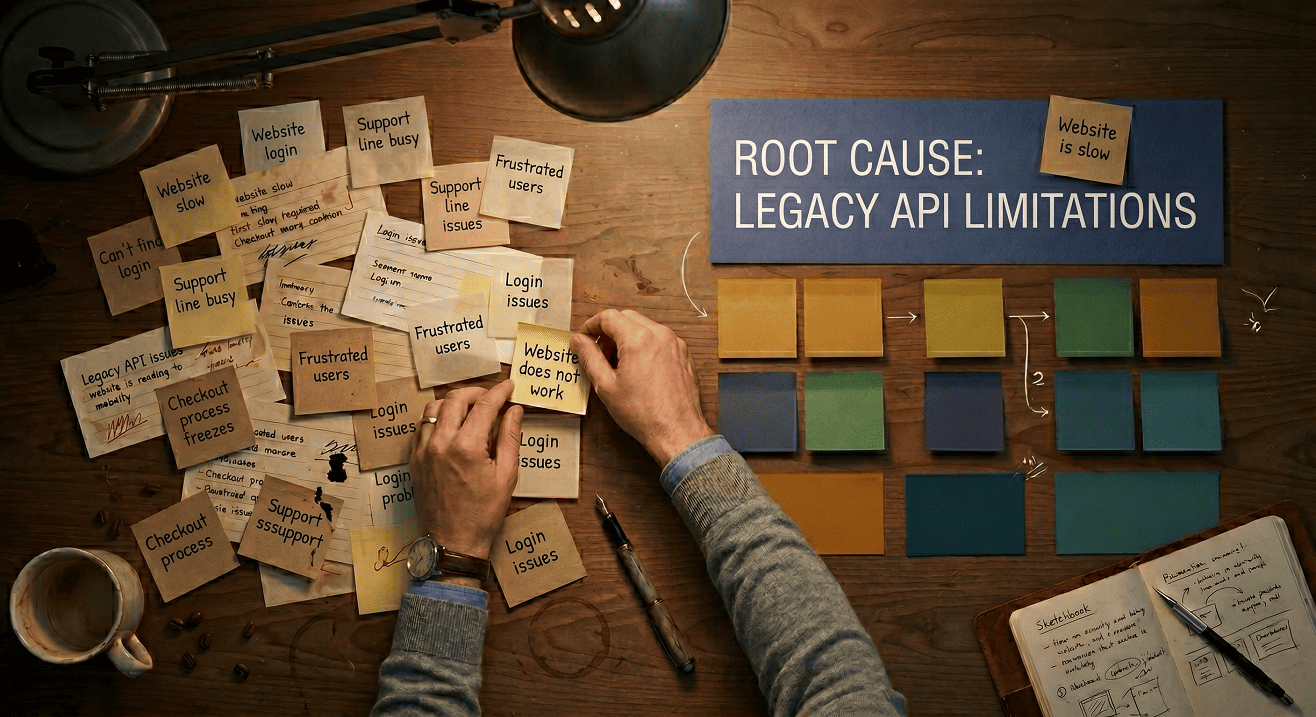
- research synthesis to identify patterns and root causes in feedback
What design thinking changes for CX teams
The value of design thinking is not creativity. It is clarity and independence.
When CX teams can understand systems, identify root causes and interpret customer feedback effectively, they become faster and more capable of solving problems. Instead of reacting to issues, they begin to prevent them.
This is the core outcome of CX capability building, where CX evolves from a reporting function into a structured, organisation-wide capability for improvement.
From measuring experience to designing it
At Experience Haus, we believe that the tools of design are too powerful to be kept in a silo. By bringing service design methodologies into the CX and Operations departments, businesses stop simply measuring the experience and start actively engineering it.
The goal is not to turn your CX managers into designers. The goal is to give them the design-led problem-solving skills they need to ensure the customer journey is intentional, repeatable, and, above all, seamless.
Ready to upskill your team? Explore our corporate training programmes and discover how we help CX leaders build internal design capabilities that drive real-world business results.